
Last spring, UBC’s Advanced Professional Certificate in Behavioural Insights hit a couple of major milestones: Our 5th cohort of learners graduated from the program, and we completed our 30th capstone project! We want to take a moment to celebrate the accomplishments of our wonderful students and look back at their amazing capstone projects.
Using Behavioural Insights to Make a Difference
In capstone projects, teams of learners use the RIDE model to apply behavioural insights (BI) to real-world problems faced by organizations in the public, non-profit, and private sectors. Although they tackle an extremely wide variety of problems, all capstone projects use BI to “nudge for good” and have a positive impact on people, communities, and/or the planet. In the list below, we share links to project write-ups or presentations (where available).
Encouraging Sustainable Behaviours
Improving waste sorting and small appliance recycling
Encouraging sustainable food choices at schools and in hospitals
Shifting customers to paperless communications and buying local products
Improving Public Health & Safety
Increasing organ donor registration
Encouraging uptake of mental health services and virtual health care programs
Helping injured workers return to work (twice!) and protecting small business owners in case of injury
Encouraging contractors to display their licenses and customers to choose licensed contractors
Increasing Compliance and Uptake
Discouraging illegal dumping, parking in restricted zones, and parking without paying
Reminding disputants to attend hearings and businesses to renew licenses
Increasing engagement with home-sharing opportunities
Changing Employee Behaviour
Shifting employees toward better documentation and better collaboration with clients
Improving how employees respond to phishing attacks
Increasing Equity, Diversity, & Inclusion (EDI)
Reducing bias in evaluations and gendered impacts of policy
Increasing engagement with EDI programming
Improving Financial Security
Helping people reduce credit card debt and plan for retirement
Supporting the unemployed in accessing services and learning how to improve these services
Below, we profile five outstanding projects in learners’ own words. For more details and additional projects, visit the BI wiki.
2024-2025: Testing Framing and Simplification to Increase Engagement with a Contractor Search Tool
Julie Wilson, Alison Schatz, James McNeill, & Monika Spence
(Advisor: David Hardisty)
Encouraging safer hiring decisions means getting people to use public safety tools. We partnered with Technical Safety BC to test whether email framing and web simplification could nudge more people to use the “Find a Licensed Contractor” tool, finding mixed results across click-through rates and completed searches.
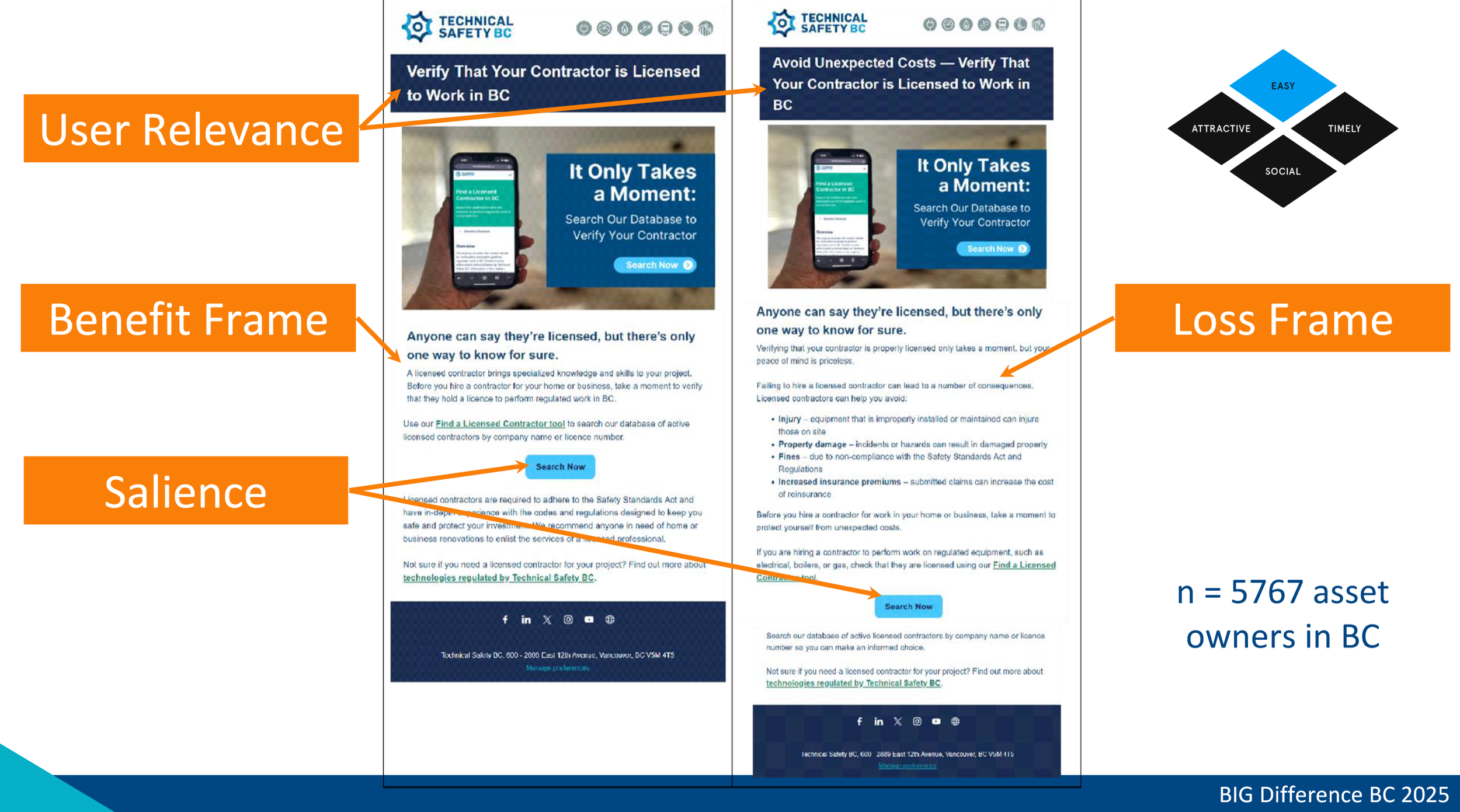
Comparison of two different emails used to encourage people to use licensed contractors.
2023-2024: Increasing Organ Donor Registrations Among BC Public Servants Using E-Newsletters
Amy Watt, Karen Smallwood, Shellee Ritzman, & Talent Pun
(Advisor: Katherine White)
This project explores the effectiveness of low-cost, scalable behavioural interventions—specifically through targeted e-newsletters—to increase organ donor registrations in British Columbia, addressing the post-pandemic decline and enhancing the province's capacity to meet the demand for lifesaving transplants.
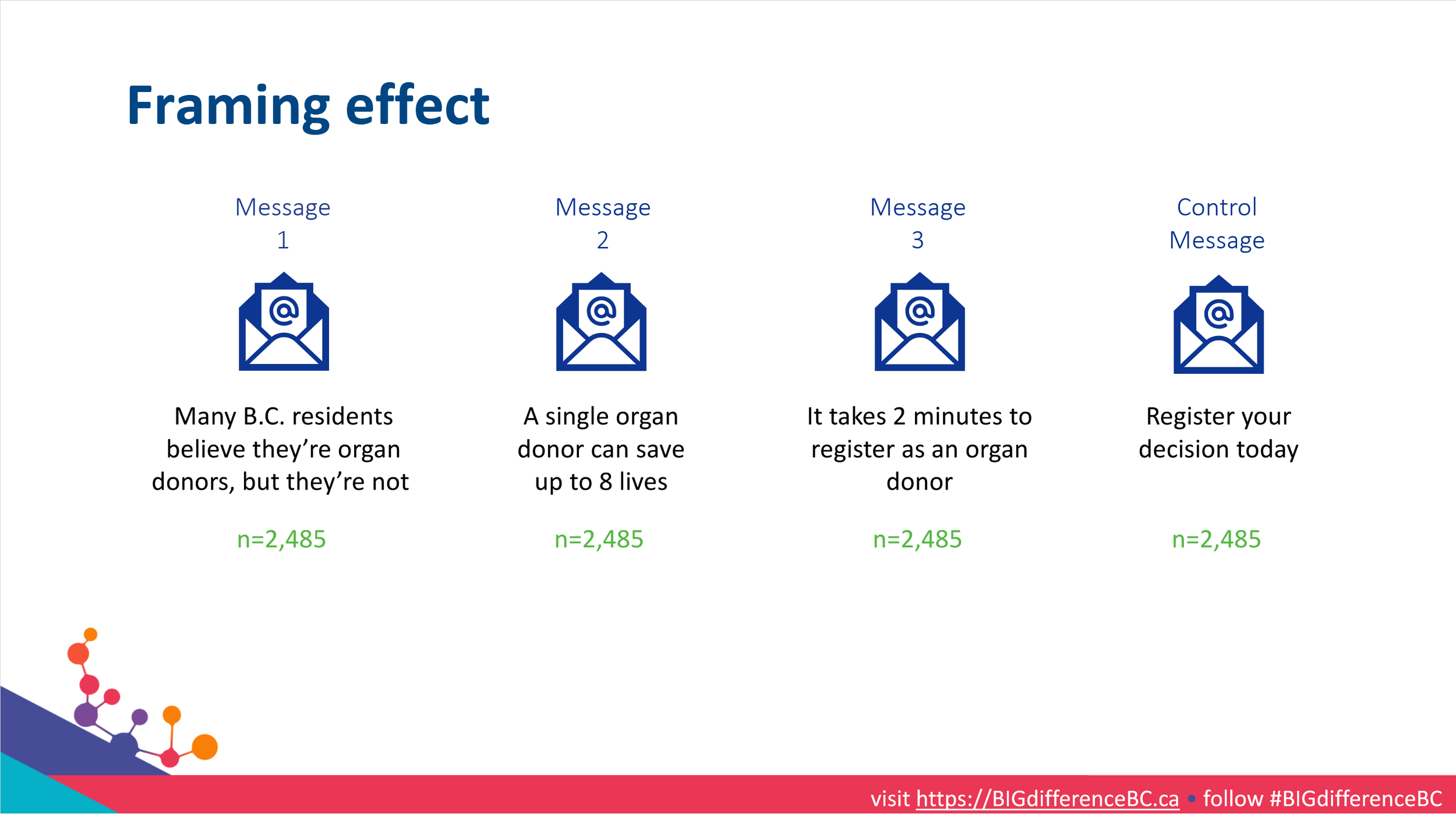
Comparison of four different messages used to encourage people to register as organ donors.
2022-2023: Promoting Sustainable Food Choices in Hospital Cafeterias
Karina Spoyalo, Nicole Viduka, & Sarah-Jean Dixon
(Advisor: Jiaying Zhao & Project Partner Andrea MacNeill)
In partnership with Vancouver Coastal Health (VCH), this project assessed the impact of salience and availability on sustainable food choices within hospital cafeteria settings. The sales of low carbon dishes increased with both interventions, demonstrating a promising method for reducing the environmental impact of healthcare's food service industry.
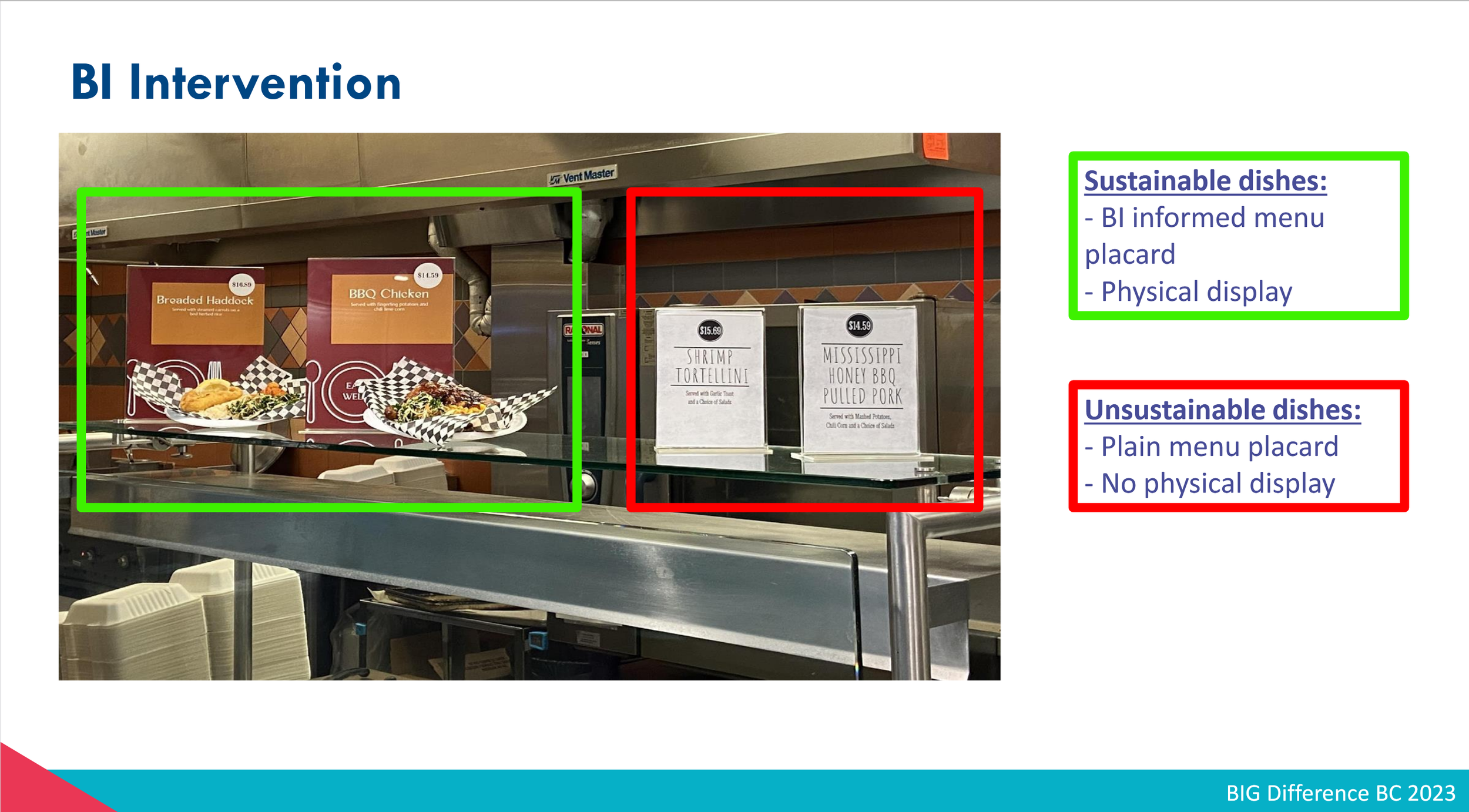
Comparison of control and behaviourally-informed menus used to encourage cafeteria patrons to choose sustainable dishes.
2021-2022: Shifting to Digital Communications
Amalia Colussi, Dana Hubackova, & Shannon McDonaugh
(Advisor: Kirstin Appelt)
We trialled an email nudge to encourage working members of a Canadian public sector pension plan to choose digital delivery for their pension information. Email nudges significantly increased the number of plan members who logged into their online pension account and switched to digital delivery.
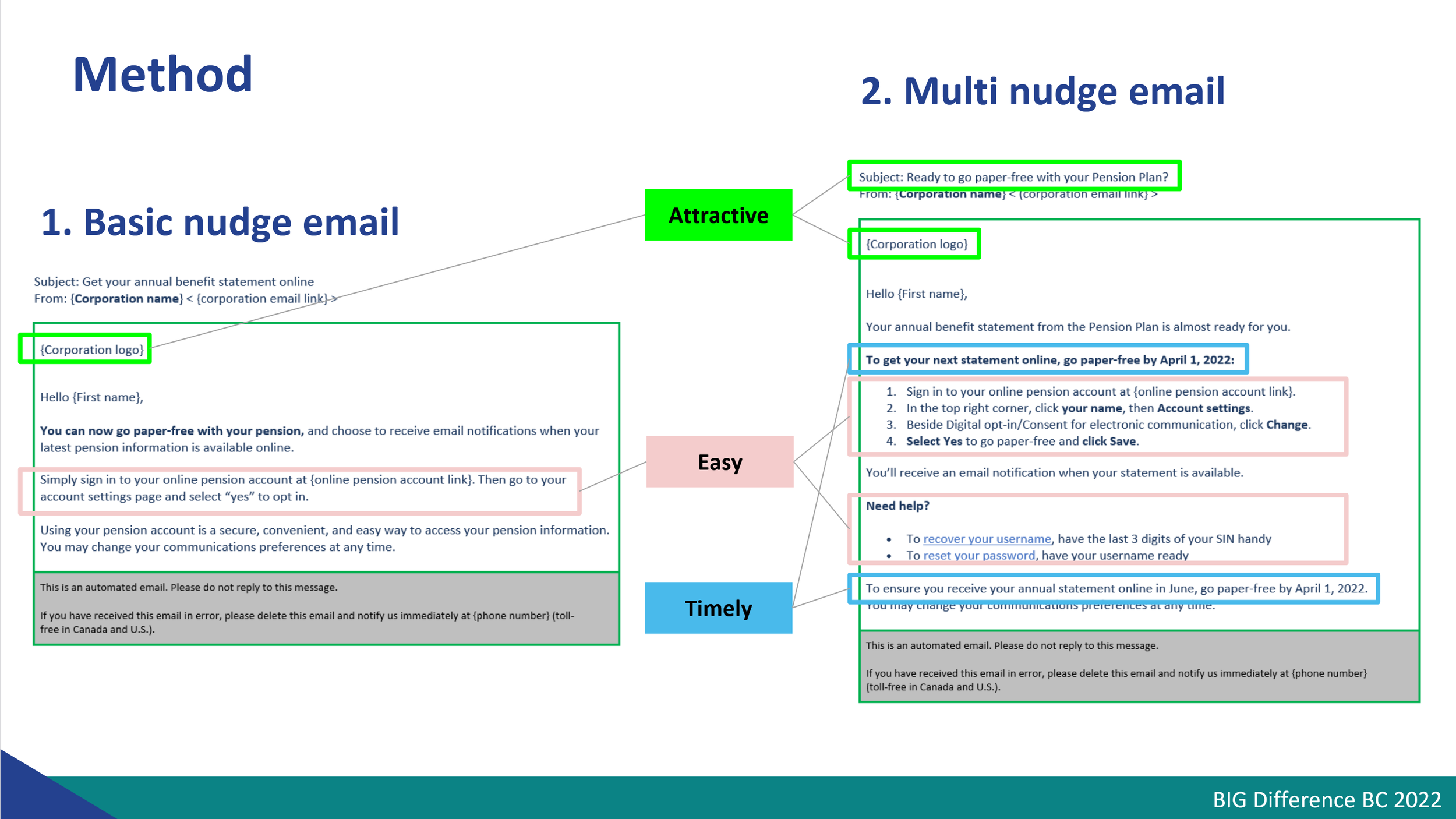
Comparison of basic and multi-nudge emails used to encourage recipients to switch to digital delivery.
2020-2021: Optimizing Attendance at Tenancy Dispute Resolution Hearings through Behaviourally Informed Email Reminders
Alexis Gordon, Emily Medd, & Lindsay Miles-Pickup
(Advisor: Kirstin Appelt)
This project set out to optimize tenancy dispute resolution hearing attendance in British Columbia by taking a behaviourally informed approach to update existing emails reminding tenants and landlords of their upcoming hearing. The updated reminder emails did not have an impact on hearing attendance behaviour, however cases with email addresses on file for both parties (applicants and respondents) had better attendance outcomes compared to cases with missing email addresses.
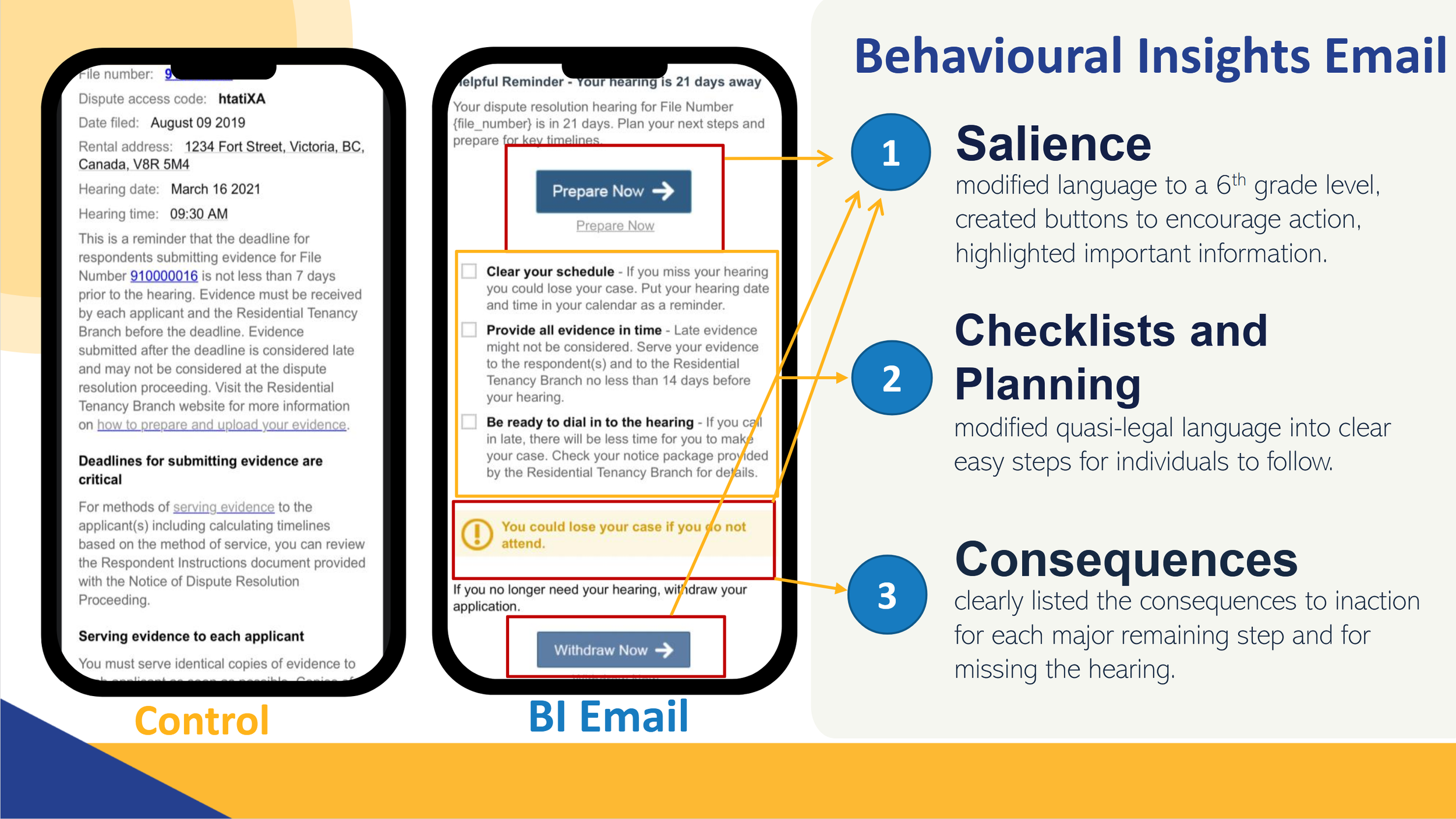
Comparison of basic and behaviourally-informed emails used to encourage recipients to attend scheduled hearings.
Curious about how BI can help you tackle
the problems that matter to you?
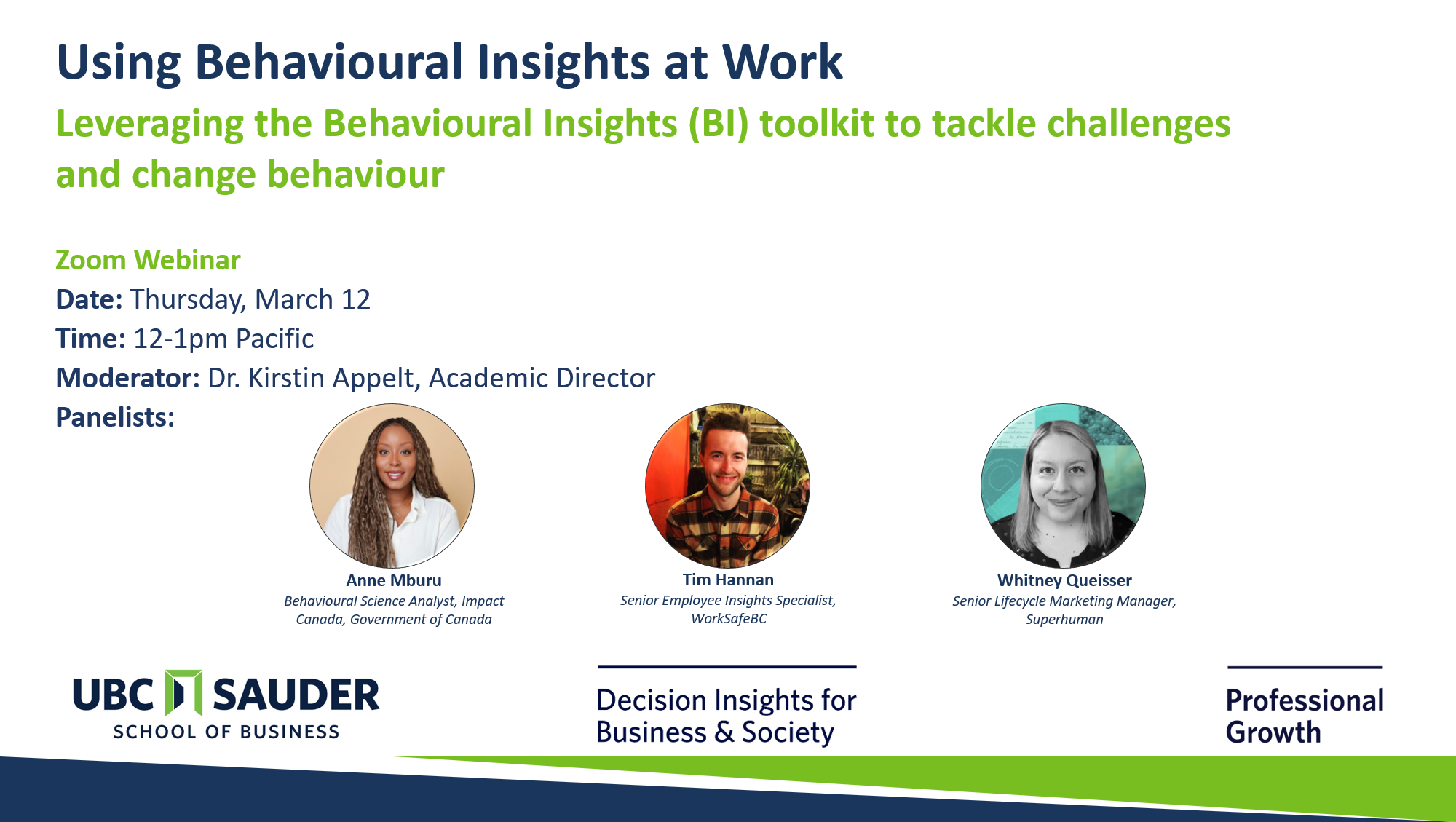
Sign up for a free webinar on using BI at work. Join us on Zoom at 12-1pm Pacific on March 12, 2026.
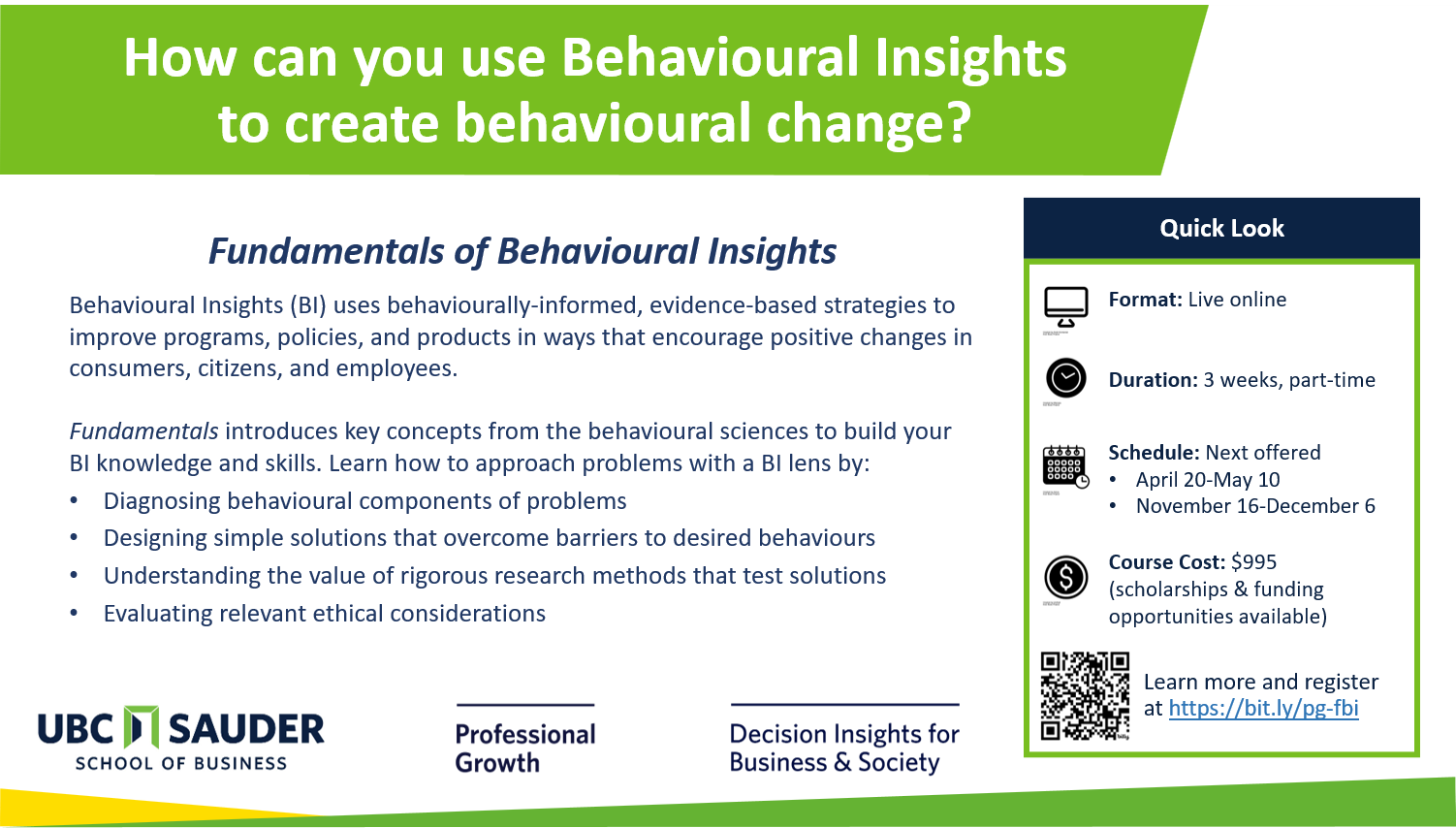
Register for UBC’s online Fundamentals of Behavioural Insights course. Next offered April 20-May 10, 2026.
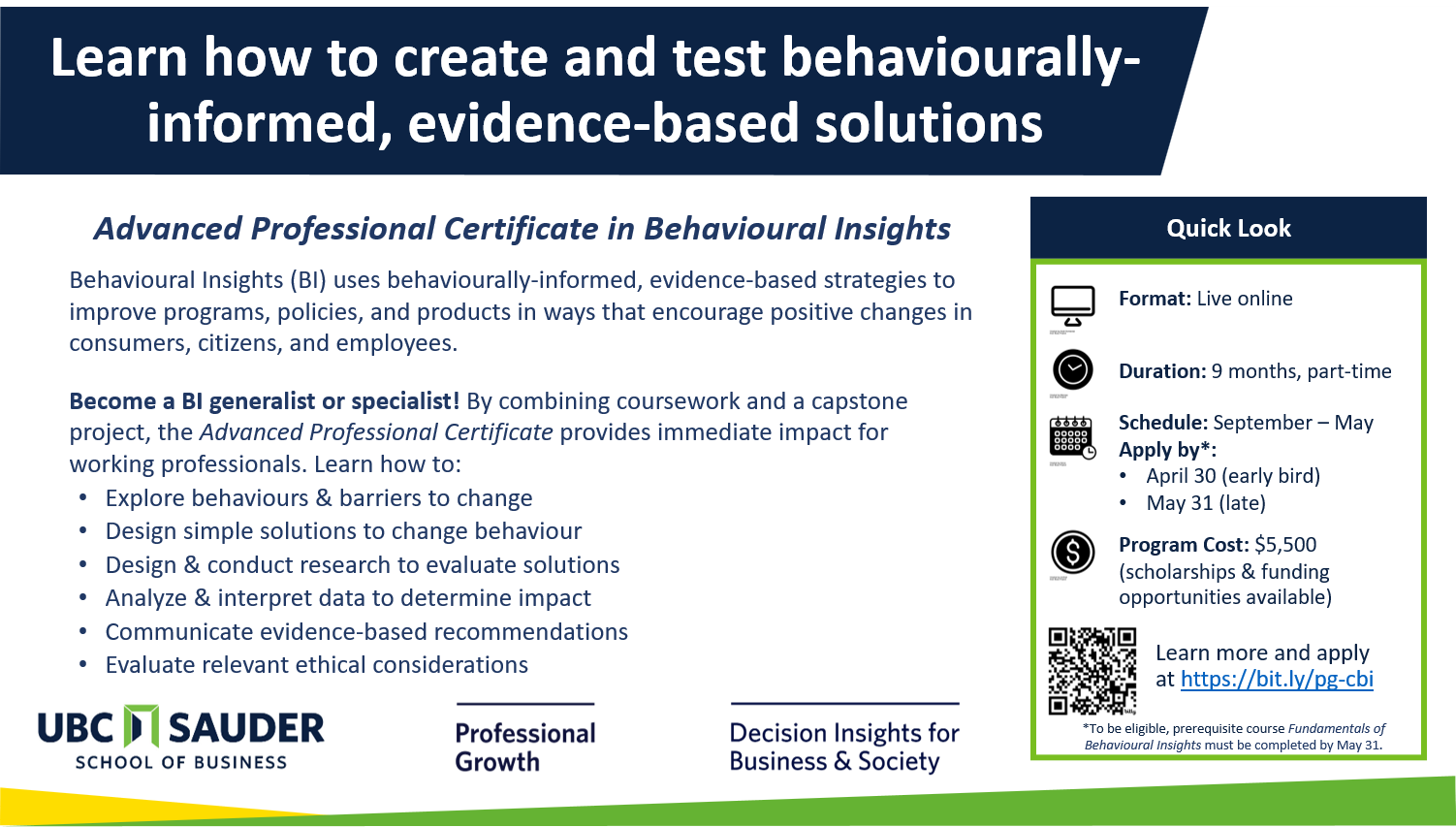
Apply for UBC’s online Advanced Professional Certificate in Behavioural Insights. Applications due by May 31 for the 2026-2027 cohort.
About the Author

Dr. Kirstin Appelt
Kirstin is the Research Director for UBC’s Decision Insights for Business & Society (UBC-DIBS) research cluster, the Academic Director for UBC’s Advanced Professional Certificate in Behavioural Insights, and the Academic Director for UBC’s Peter P. Dhillon Centre for Business Ethics. Her research explores why we struggle with important decisions about the future and how choice architecture can help us make the best decisions for ourselves, our communities, and the planet.