
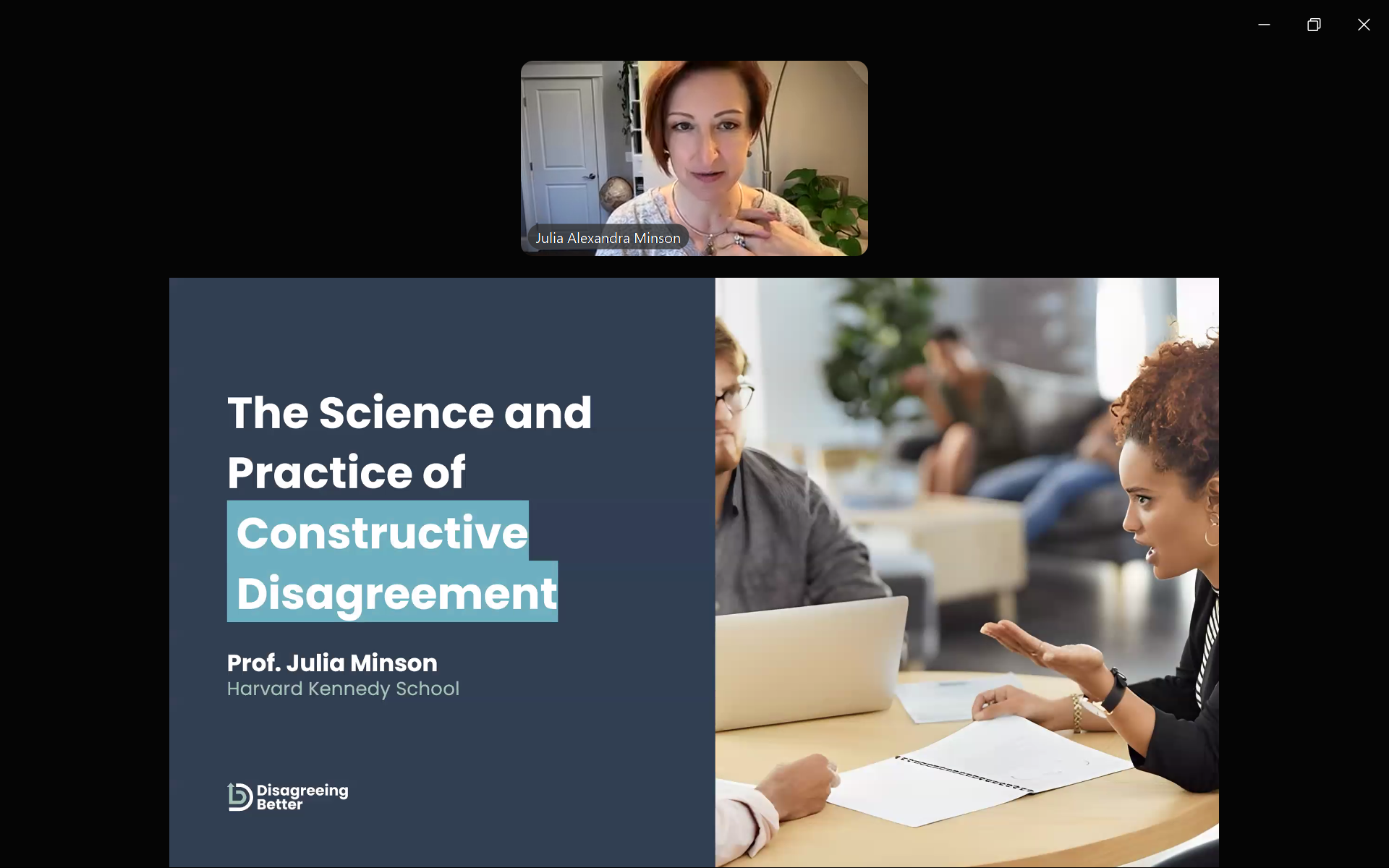
Dr. Julia Minson presenting the keynote, “The Science and Practice of Constructive Disagreement”.
Each year, BIG Difference BC brings together researchers and practitioners using behavioural science to tackle real-world challenges. This year, those challenges ranged from keeping girls in school and supporting teen mental health to increasing organ donation, encouraging climate action, improving government services and strengthening public trust.
The theme of BIG Difference BC 2026 was Building Resilient Futures with Behavioural Insights. Across the day, one idea kept surfacing for me: resilience isn't simply a quality we ask people or institutions to develop. We can design conditions that make resilient behaviours easier. Sometimes that means helping someone plan before they're under pressure. Sometimes it means removing friction from a government service. And sometimes it means creating space for people with very different perspectives to hear one another.
Here are my three key takeaways from BIG Difference BC 2026:
1. Don't just communicate differently. Design for the moment when behaviour happens.
Several presentations reminded me that effective behavioural interventions start with understanding the moment in which someone actually needs to act. For example, as we saw in the afternoon talk on climate action: Waiting until your furnace breaks in the middle of winter isn't a particularly good moment to carefully investigate whether a heat pump is right for you. Instead, we need to reach people before the moment of crisis or decision!
Work in Zambia sought to help girls stay in school through workshops with girls and caregivers that challenged perceived social norms, used stories from local women, encouraged girls to envision their futures, and helped them develop if-then plans for overcoming barriers. These were also based on an intervention developed by Gabriele Oettingen: WOOP (Wish, Outcome, Obstacle, Plan). This helped turn an aspiration, such as graduating from school, into something more tangible and actionable through collaborative problem solving and commitment devices.
In Uruguay, a much lighter-touch intervention produced meaningful results. Brief, personalized messages alerted families to accumulated school absences and encouraged greater monitoring. The intervention cost roughly $1 per student, illustrating how timely, targeted communication can make an important behaviour more salient without requiring an elaborate solution.
And a California teen mental-health initiative went beyond simply telling young people to look after their mental health. It identified a behavioural journey in which pressures accumulate until a teen reaches a breaking point, followed by negative coping and repetition of the cycle. The intervention introduced a new possibility earlier in that journey: Taking space to pause. It gave young people concrete ways to recognize and respond to mounting stress before reaching that breaking point.
The common thread among these presentations?
Meeting people where the behaviour happens.
People often know broadly what they "should" do. The behavioural opportunity may instead be helping them notice the right moment, anticipate the obstacle, reduce the effort required or have a plan ready before circumstances make the decision harder.
Resilience, in other words, can sometimes be designed in advance.
2. Trust isn't just something institutions have. It's something they do.
Trust was one of the strongest threads running through this year's conference, particularly during the special session, Trust & Behavioural Insights.
One point that stayed with me was the idea of trust as a strategic asset rather than simply a communications objective.
Martine St-Victor described trust as something that can be measured, built and brokered. Importantly, trust exists within an ecosystem. Organizations don't have just one trust relationship. Employees, customers, citizens, communities and institutions interact with one another, and those relationships can reinforce or undermine trust.
This creates an interesting need for trust brokers: People and organizations capable of working across divides, paying attention to whose voices aren't being heard and finding shared interests without minimizing meaningful differences.
Haris Khan's discussion of the Organisation for Economic Co-operation and Development’s trust research brought the idea closer to the everyday work of government. Behavioural insights can help institutions create mechanisms through which citizens genuinely feel heard, build shared understanding of difficult issues and improve people's experience of government by removing unnecessary barriers and sludge.
Nicholas Diamond added another useful lens:
Ability + care + integrity = trustworthiness.
That framing moves trust away from "How can we convince people to trust us?" and toward a much more useful question:
What can we do to become more trustworthy?
That might mean demonstrating competence. It might mean showing that we understand people's experiences. It can mean greater transparency about how decisions are made.
And importantly, trust isn't static. People's information environments are changing, social media platforms shape what people see and we are susceptible to biases such as the false consensus effect, in which we overestimate how widely other people share our own beliefs.
Building trust therefore requires listening and adapting, not simply communicating more.
3. Disagreement can make us stronger, if we design for it.
Julia Minson's keynote on “The Science and Practice of Constructive Disagreement” offered another perspective on resilience.
Disagreement has an unusual incentive structure: The potential benefits of speaking up, such as the team eventually making a better decision, may arrive later and be shared by everyone. But the potential cost of disagreeing with colleagues can feel immediate, personal and certain. It's hardly surprising that people sometimes remain quiet!
An especially useful distinction was between disagreement and conflict. Disagreement is simply a difference in beliefs, expectations or preferences. Conflict emerges when that disagreement is accompanied by negative judgments and emotions. The goal isn't to eliminate disagreement. It's to keep disagreement from becoming conflict.
A memorable definition of constructive disagreement was disagreement that increases the parties' willingness to speak to one another again. One practical tool for doing this is the H.E.A.R. Framework:
Hedge your claims: "I think it's possible that..."
Emphasize agreement: "I think we both want to..."
Acknowledge the other perspective(s): "I understand that..."
Reframe to the positive: "I would appreciate it if..."
The aim isn't to make everyone agree, rather it’s to signal that you are receptive to the other parties’ perspective. Receptiveness to opposing views doesn't require compromising or changing your mind. It means being willing to fairly consider views that support and challenge your own position.
Curiosity and storytelling can help, too. When people explain the experiences behind a position rather than simply defending the position itself, others gain an opportunity to understand why it matters to them.
There's an important connection here with trust. Institutions need people to voice concerns and different perspectives if they want to make good decisions. But people need to believe that disagreement won't come at an unacceptable personal cost.
Resilient organizations don't eliminate disagreement. They get better at having it.
Closing thoughts: Resilience is something we build together
One final presentation tied several of these ideas together for me.
The organ donation work presented by the BC Behavioural Insights Group and Ontario Behavioural Insights Unit showed what can happen when behavioural science itself becomes iterative and collaborative.
The work built on an opportunity created through the Canada Revenue Agency and provincial organ donation organizations. Ontario began an email campaign in 2024. In 2025, BC Transplant worked with the BC Behavioural Insights Group to test behaviourally informed emails. In 2026, the Ontario Behavioural Insights Unit built on that earlier work for another behaviourally informed campaign.
What I like about this example isn't simply the intervention. It's the model. Try something. Learn. Share. Build on what someone else has learned. Test again. That is resilience at a system level.
Looking across BIG Difference BC 2026, my three key takeaways seem closely connected:
Design for the moment. Make positive behaviours easier before people find themselves under pressure.
Earn trust through experience. Listening, transparency and better services can be behavioural interventions, too.
Make disagreement productive. Resilient teams and institutions need different perspectives, along with the skills and environments to express them constructively.
Maybe that's one of the most encouraging lessons from this year's conference: Behavioural science doesn't need to make people endlessly more resilient to difficult systems. Sometimes our job is to design more resilient systems around people.
NOTE: Microsoft Copilot Premium was used to develop this content drawing from the 2026 BIG Difference BC program and my personal notes from the day. It used the 2025 conference reflections blog as inspiration.
About the Author

Carl Jensen
Carl Jensen is Project Director of the BC Behavioural Insights Group, a behavioural science consultancy unit within the Government of British Columbia.